
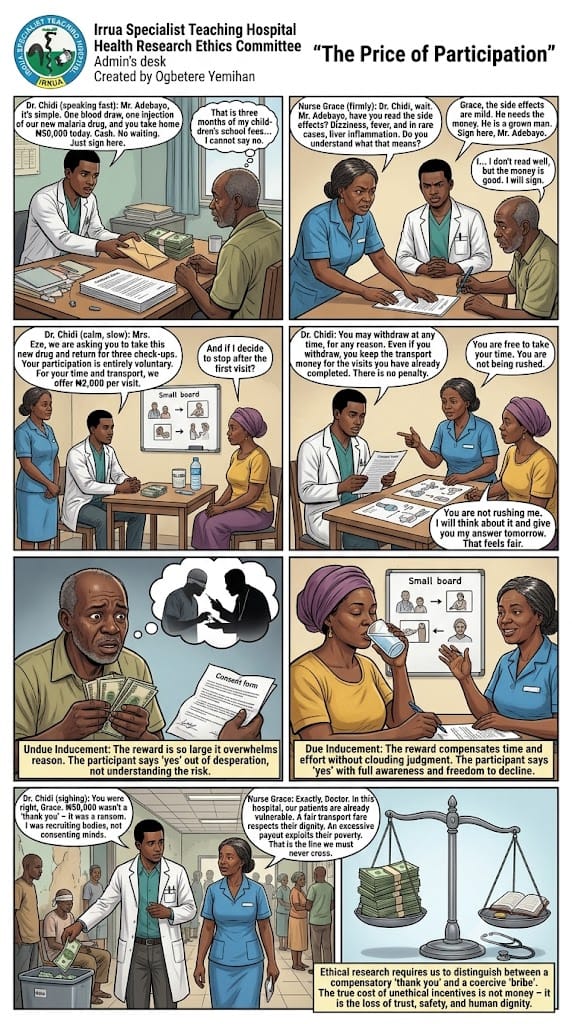
You offer ₦50,000. Or $500. Or €400.
Recruitment soars. Consent forms fill up fast.
Problem solved? ❌
Problem created. ✅
When the incentive is too large, participants say “yes” for the money, not for the science. They do not read the consent form. They do not understand the risks.
That is not informed consent. That is induced consent.
And it is unethical. Everywhere. 🌍
⚖️ The test is simple:
Would a financially secure person still join for this amount?
· If YES → Fair compensation ✅
· If NO → Undue inducement ❌
What works:
· Transport reimbursement 🚌
· Modest time compensation ⏳
· Clear withdrawal rights 🚪
· Community input on amounts 🗣️
What doesn’t:
· Bonuses for completing all visits 🎯
· Gifts worth months of income 🎁
· Rushed consent processes 📄
· No justification for the amount ❓
📋 WHAT TO CONSIDER WHEN SETTING INCENTIVES:
🔹 Burden of participation
How much time, travel, discomfort, or risk is involved? The incentive should match the burden.
🔹 Population vulnerability
Are you working with low-income, illiterate, or otherwise marginalised groups? If yes, the bar for “undue inducement” is much lower.
🔹 Local context
A ₦10,000 incentive in a rural community may be coercive. The same amount in an urban setting may be reasonable. Know your context.
🔹 Comparability
What do other studies in the same setting offer? If yours is significantly higher, ask yourself why. Justify it.
🔹 Withdrawal clause
Can participants withdraw at any time and still keep compensation for completed visits? If not, you are trapping them.
To every researcher reading this:
Your incentive should say “We value your time” not “We will buy your decision.”
The line is thin. Cross it, and you lose trust. Protect it, and you protect dignity.
That is the real cost of getting it wrong.
🛡️
Brought to you by Irrua Specialist Teaching Hospital Health Research Ethics Committee Approved for educational purposes only